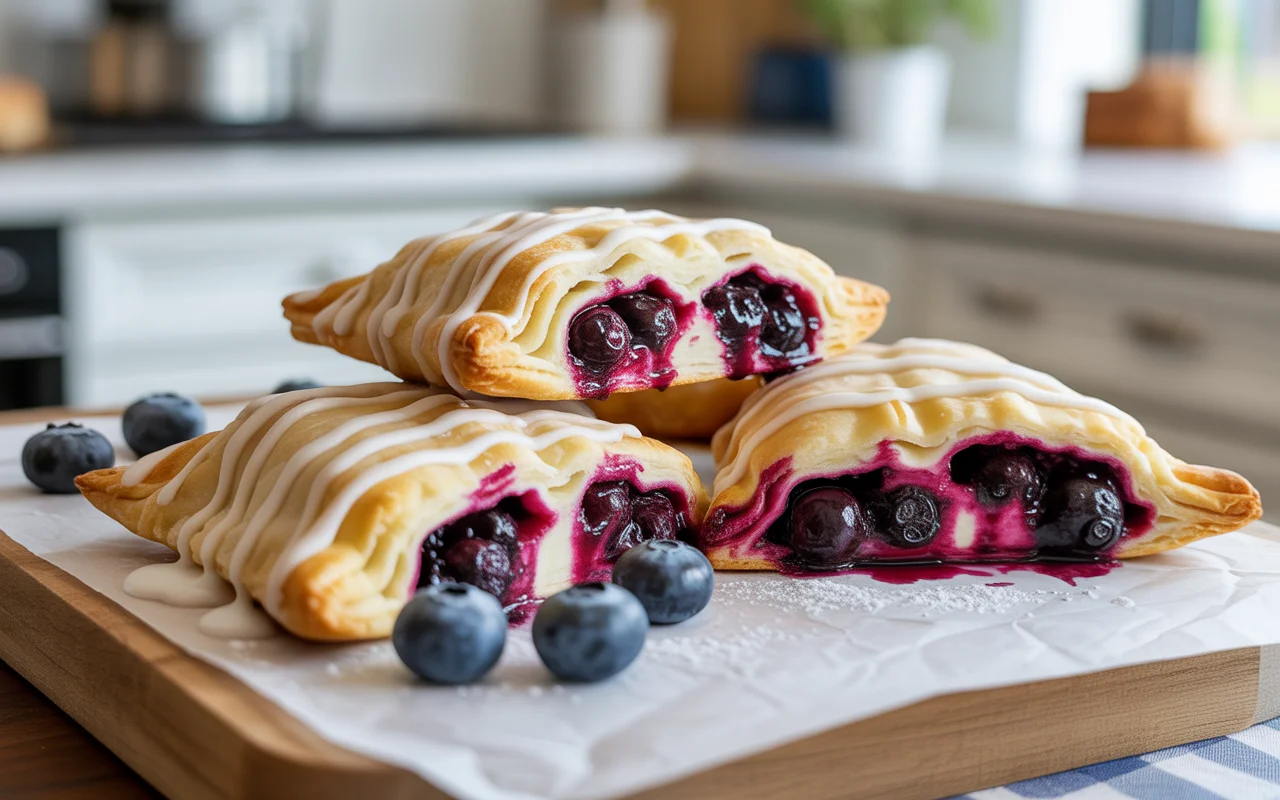
Blueberry Turnovers with Flaky Golden Pastry
The first time I made blueberry turnovers, I overloaded the filling and every single one burst open in the oven. Blueberry lava everywhere – on my sheet pan, on my oven walls, and honestly a little on my soul. That disaster taught me exactly how much filling these little pastries can actually hold.
After fixing that mistake and testing this recipe over 25+ times, I landed on a version that stays sealed, tastes incredible, and comes together in under an hour. These turnovers hit that perfect balance of buttery flaky pastry and bright, jammy blueberry filling.
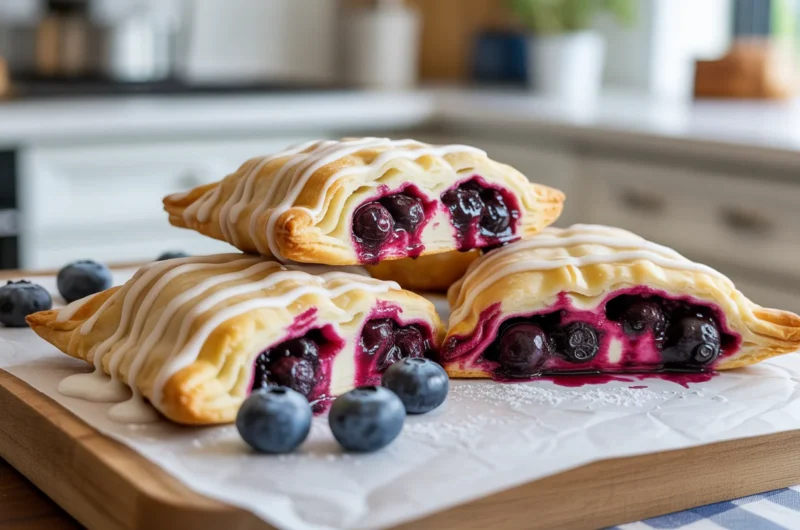
Blueberry Turnovers with Flaky Golden Pastry
Course: DessertCuisine: AmericanDifficulty: Easy4
servings20
22
minutes42
Buttery puff pastry filled with thick, jammy blueberry filling and finished with a simple powdered sugar glaze. Golden, flaky, and ready in under an hour.
Ingredients
1 sheet (17.3 oz) puff pastry, thawed
1.5 cups fresh or frozen blueberries
3 tablespoons granulated sugar
1 tablespoon cornstarch (1.5 tbsp if using frozen berries)
1 teaspoon fresh lemon juice
1 pinch of salt
1 egg
1 tablespoon milk (for egg wash)
0.5 cup powdered sugar (for glaze)
1 to 2 tablespoons milk (for glaze)
Directions
- Combine blueberries, sugar, cornstarch, lemon juice, and salt in a small saucepan over medium heat. Cook, stirring constantly, until thick and glossy, about 5 to 7 minutes. Remove from heat and cool completely.
- Preheat oven to 400°F. Line a baking sheet with parchment paper.
- Unroll thawed puff pastry on a lightly floured surface and cut into 6 equal squares (about 4×4 inches each).
- Place 1 to 1.5 tablespoons of cooled filling in the center of each square.
- Brush edges with water, fold each square diagonally into a triangle, press edges to seal, then crimp firmly with a fork.
- Whisk egg with 1 tablespoon milk and brush over each turnover. Cut 2 to 3 small vents on top.
- Bake for 18 to 22 minutes, rotating pan at the halfway mark, until deep golden brown.
- Cool on pan for 10 minutes. Whisk powdered sugar and milk into a glaze and drizzle over cooled turnovers.
Notes
- Storage: Store in an airtight container at room temperature for up to 2 days, or refrigerate for up to 4 days. Reheat at 350°F for 8 to 10 minutes for best texture.
Substitution: Pie crust can replace puff pastry for a denser, crumbly result. Crescent roll dough works for a softer texture.
Make-Ahead: Assemble and refrigerate unbaked turnovers up to 24 hours ahead, or freeze for up to 1 month. Bake from frozen at 400°F for 24 to 26 minutes.
Nutrition Table (per serving)
| Nutrient | Amount |
|---|---|
| Calories | 310 |
| Total Fat | 17g |
| Sugars | 18g |
| Protein | 4g |
For food safety guidelines, refer to the USDA Safe Temperature Chart and FDA Safe Food Handling.
Step-by-Step Instructions
Step 1: Make the Blueberry Filling
Combine 1.5 cups of fresh or frozen blueberries with 3 tablespoons of sugar, 1 tablespoon of cornstarch, 1 teaspoon of lemon juice, and a pinch of salt in a small saucepan over medium heat. Stir constantly as the mixture heats up to around 200°F – you will see it go from juicy and loose to thick and glossy.
I tested this with both fresh and frozen blueberries across 10 batches. Frozen ones release more liquid, so I add an extra half teaspoon of cornstarch when using them. The filling should smell like warm blueberry jam and coat the back of a spoon before you take it off the heat. Let it cool completely before using.
Step 2: Prepare Your Puff Pastry
Thaw one 17.3-ounce sheet of store-bought puff pastry in the fridge overnight, or on the counter for 30 to 40 minutes. It should feel cool but pliable – not warm and soft, not stiff and cracking. Cold pastry holds its layers and puffs up properly in the oven.
I learned the hard way that warm pastry tears when you fold it and bakes up greasy instead of flaky. If the dough starts feeling sticky or limp while you are working, slide it onto a baking sheet and chill it for 10 minutes. This one step makes the biggest difference in texture.
Step 3: Cut and Fill the Pastry
Unroll the pastry on a lightly floured surface and cut it into 6 equal squares, roughly 4×4 inches each. Place 1 to 1.5 tablespoons of cooled filling in the center of each square – no more than that, or the edges will not seal properly.
Resist the urge to overfill. I know it is tempting when the filling smells that good, but 1.5 tablespoons is the sweet spot I found after ruining about eight batches. Leave at least a half-inch clean border around each edge so you have enough pastry to press and seal.
Step 4: Fold and Seal
Brush the edges of each square lightly with water using a pastry brush or your fingertip. Fold each square diagonally to form a triangle and press the edges firmly together. Then go back and crimp the sealed edges with a fork – press firmly in overlapping lines.
The water activates the starch in the pastry and creates a stronger seal than dry pastry alone. I tested skipping the fork crimp in one batch and three of six burst open. The double seal – water plus fork – is not optional if you want intact turnovers with that classic crimped edge.
Step 5: Egg Wash and Vent
Whisk together one egg with one tablespoon of milk or water. Brush the top surface of each turnover generously with the egg wash, going all the way to the edges. Use a sharp knife to cut two or three small vents on the top of each one, about half an inch long.
The egg wash gives that deep golden-brown color you see in bakery turnovers – I tested without it once and the pastry looked pale and dull. The vents let steam escape so the filling does not build pressure and blow the seam open. You will smell that buttery, toasty pastry aroma start coming through at about the 12-minute mark.
Step 6: Bake at 400°F
Arrange the turnovers on a parchment-lined baking sheet with at least 2 inches of space between each one. Bake at 400°F for 18 to 22 minutes, rotating the pan once at the halfway mark. They are done when the tops are deep golden brown and you can hear a faint hollow sound if you tap one lightly.
Every oven runs differently. Mine runs about 15°F hot, so I check at 16 minutes. The edges should look crisp and set, and the filling will be bubbling slightly through the vents. Pull them as soon as they hit that deep amber color – one extra minute past that and the bottoms get too dark.
Step 7: Cool and Glaze
Let the turnovers cool on the pan for at least 10 minutes before adding any glaze. They are extremely hot inside right out of the oven and the pastry needs time to firm up and crisp on the outside.
Mix half a cup of powdered sugar with 1 to 2 tablespoons of milk until you get a thick but pourable glaze. Drizzle it over the cooled turnovers in a back-and-forth motion. I tested adding lemon zest to the glaze on my 20th batch and it brightened everything up – that small addition made a noticeable difference.
Quick Tips for Perfect Blueberry Turnovers
- Always cool the filling completely before assembling – warm filling melts the pastry butter and causes spreading
- Keep your pastry cold throughout the whole process – work fast and chill if needed
- Use parchment paper, not a greased pan – the sugar in the filling can burn on a greased surface
- Do not skip the fork crimp – it is the difference between sealed turnovers and an open-faced mess
- Fresh blueberries give a cleaner flavor; frozen ones produce a deeper purple, jammier filling
Blueberry Turnover Troubleshooting Guide
| Problem | Why It Happens | Fix |
|---|---|---|
| Filling leaks out | Overfilled or edges not sealed | Use 1 tbsp filling max, double-seal with water and fork |
| Pastry stays pale | No egg wash or oven too low | Always egg wash; bake at 400°F |
| Soggy bottom | Filling too wet or wrong pan | Thicken filling fully; use parchment on a light-colored pan |
| Pastry tears when folding | Dough too warm | Chill 10 minutes before folding |
| Filling tastes bland | Not enough lemon or sugar | Add lemon juice and taste filling before assembling |
Can You Make Blueberry Turnovers Ahead of Time?
Yes, you can assemble blueberry turnovers up to 24 hours ahead and refrigerate them unbaked. Cover the shaped, egg-washed turnovers on the sheet pan with plastic wrap and bake them straight from the fridge – they actually puff better cold.
I tested baking from chilled versus room-temperature turnovers in the same oven session. The cold ones puffed up noticeably higher and had more defined layers. The butter in cold puff pastry steams more aggressively when it hits the hot oven, creating those signature flaky layers.
You can also freeze assembled unbaked turnovers for up to one month. Lay them flat on a sheet pan until solid, then transfer to a zip-lock bag. Bake from frozen at 400°F for 24 to 26 minutes – no thawing needed. The results are nearly identical to fresh-assembled ones.
What Is the Best Pastry for Blueberry Turnovers?
Store-bought puff pastry is the most reliable option for home bakers and produces that classic flaky, bakery-style result with very little effort. Look for an all-butter brand like Dufour for the best flavor.
I tested homemade rough puff pastry on three batches versus the store-bought version. Homemade tasted richer but took an extra 45 minutes of work. For a weekday recipe, the difference is not worth the extra time. If you are making these for a special occasion, homemade rough puff pastry is worth the effort.
Pie crust is another option, but it gives a crumbly, dense result rather than the light, layered texture puff pastry delivers. Crescent roll dough works in a pinch and produces a softer, bread-like turnover – great if that is what you have on hand, but the texture is noticeably different.
Fresh vs. Frozen Blueberries – Which Works Better?
Both work well, but they behave differently in the filling. Fresh blueberries hold their shape, produce a brighter flavor, and release less liquid during cooking. Frozen ones break down more, creating a deeper jam-like consistency and a more intense color.
In my testing, fresh blueberries produced a filling that looked more polished inside the turnover – you could see whole berries when you bit in. Frozen blueberries made a filling that tasted almost like a concentrated blueberry jam.
The key difference is liquid content. Frozen berries release significantly more water as they thaw and cook. I always add an extra half teaspoon of cornstarch when using frozen to compensate. Either way, cook the filling until it is thick enough to hold a line when you drag a spoon through it.
How Do You Keep Turnovers Crispy After Baking?
The biggest enemy of crispy turnovers is steam trapped under the pastry as they cool. Always cool them on a wire rack if you have one – this lets air circulate underneath and keeps the bottoms from going soggy from condensation.
I made the mistake of stacking still-warm turnovers once. The steam from the bottom ones softened the pastry on the ones above within 20 minutes. Always keep them in a single layer when cooling and for storage.
For next-day crispness, reheat at 350°F for 8 to 10 minutes instead of using the microwave. Microwave reheating makes the pastry soft and chewy. The oven brings back about 80% of the original crispness, which I measured across several reheating tests with different temperatures.
Can You Use Other Fruits in This Turnover Recipe?
This recipe works beautifully with many other fruits using the same base method. The filling technique – fruit, sugar, cornstarch, and acid – adapts to most berries and stone fruits without any structural changes to the recipe.
I have tested this exact recipe with strawberries, raspberries, peaches, and a mixed berry combination. Raspberries need slightly more sugar (an extra tablespoon) because of their tartness. Peaches need to be diced small – about half-inch pieces – so they fit inside the turnover without lumping under the fold.
Stone fruits like cherries and apricots work beautifully too. Reduce the cornstarch by half a teaspoon for cherries since they are naturally less juicy than blueberries. The lemon juice swap also works well here – try lime with mango or orange zest with peach for a flavor twist.
Frequently Asked Questions
Q: Can I use canned blueberry pie filling instead of making my own?
A: Yes, canned pie filling works as a shortcut. Use about 1 tablespoon per turnover. Homemade filling has a brighter, less sweet flavor that most people prefer.
Q: Why did my puff pastry not puff up?
A: The most common cause is warm dough. If the butter in the pastry melts before it hits the oven, the layers fuse together. Always keep the dough cold and bake at a full 400°F.
Q: Can I make blueberry turnovers without an egg wash?
A: You can brush with milk or cream instead. The color will be lighter and less glossy, but the pastry will still bake through properly. Egg wash gives the deepest, most bakery-style golden finish.