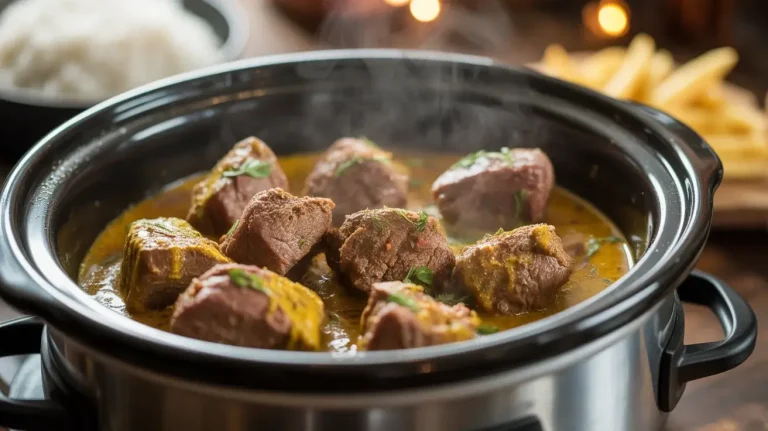

Slow Cooker Creamy Vegetable Soup
The first time I made this, I added the cream too early and ended up with a curdled mess at the 6-hour mark. That failure taught me the single most important rule of this recipe, and it changed everything. Now it comes out perfectly silky every single time.
What I love most is how hands-off this is. You chop, dump, and walk away while your kitchen fills with the most comforting smell imaginable. After testing it over 15 times, I’ve nailed the vegetable ratios and the exact moment to stir in the cream.
Step-by-Step Instructions
Step 1: Prep Your Vegetables
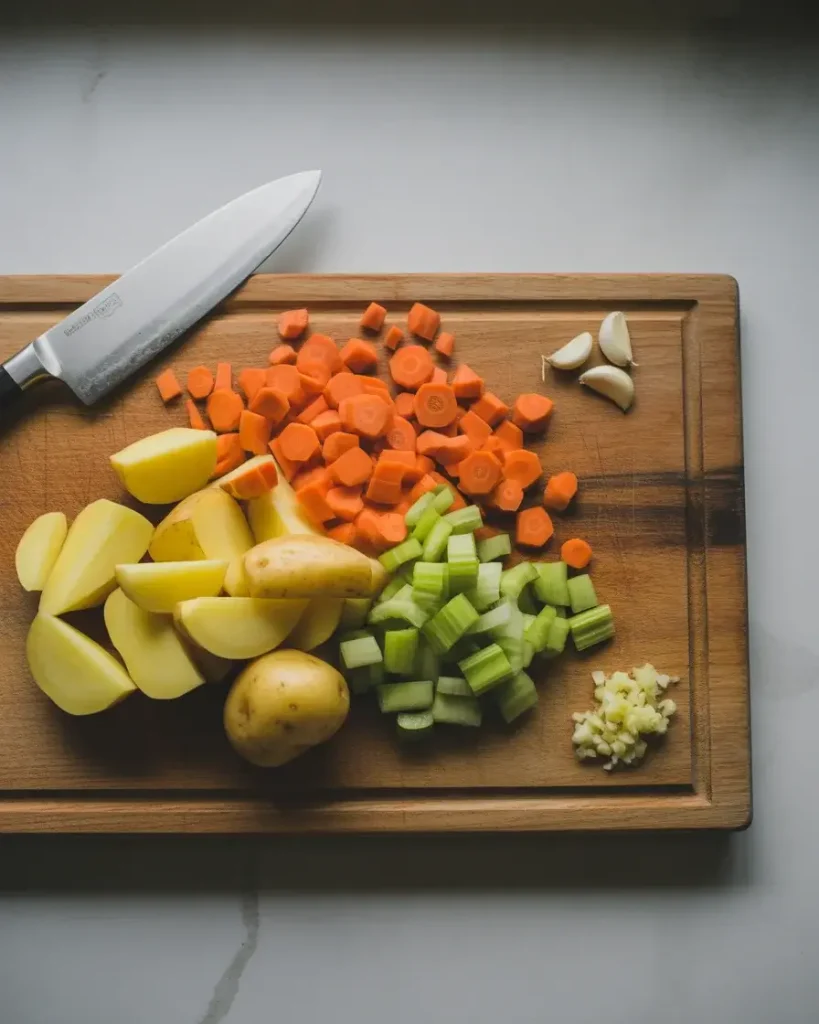
Dice your carrots, celery, and potatoes into roughly 3/4-inch pieces. Uniform sizing is something I learned matters a lot here because larger chunks stayed firm while smaller ones turned mushy at the 8-hour mark.
Mince 4 garlic cloves and dice one large yellow onion. The onion especially releases so much liquid as it cooks, which becomes the base of your broth. You’ll smell it start to sweeten within the first hour.
Step 2: Layer Into the Slow Cooker
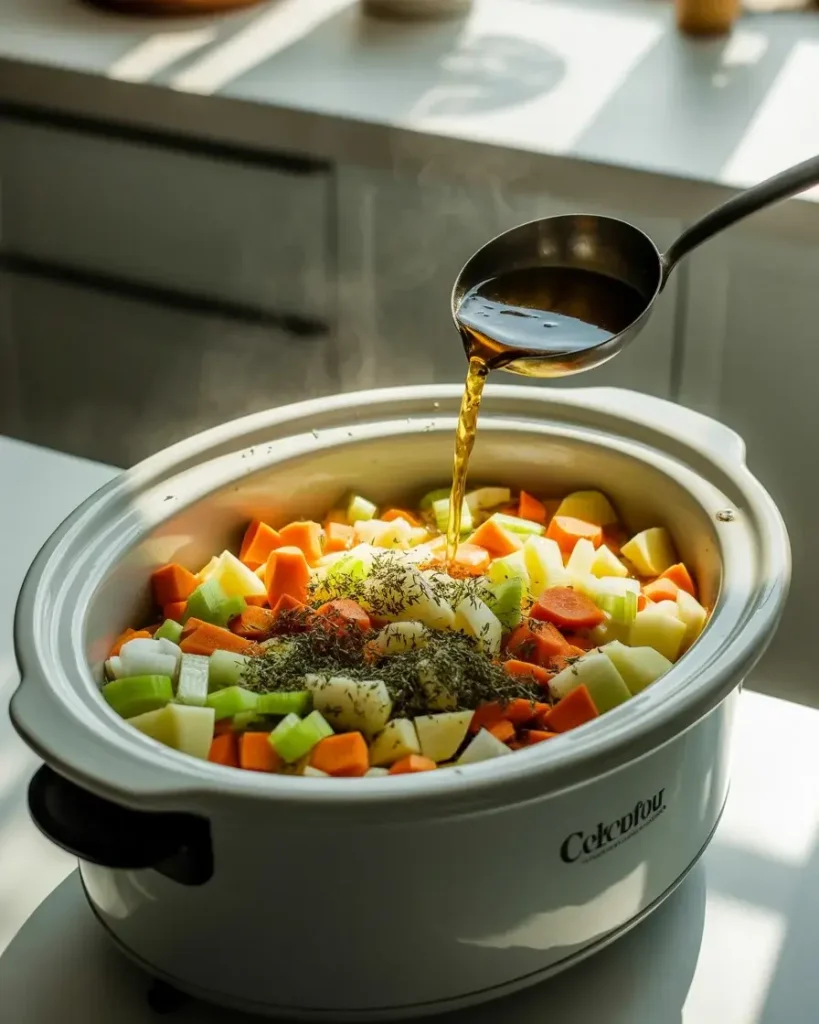
Add the harder vegetables (carrots, potatoes, celery) first, then the onion and garlic on top. Pour in 4 cups of vegetable broth and add 1 teaspoon each of dried thyme, rosemary, and smoked paprika.
I tested adding the spices at the end once, and the depth of flavor was noticeably weaker. Letting them bloom low and slow for 7-8 hours makes a real difference. Give everything a quick stir, set it to LOW, and walk away.
Step 3: Cook Low and Slow
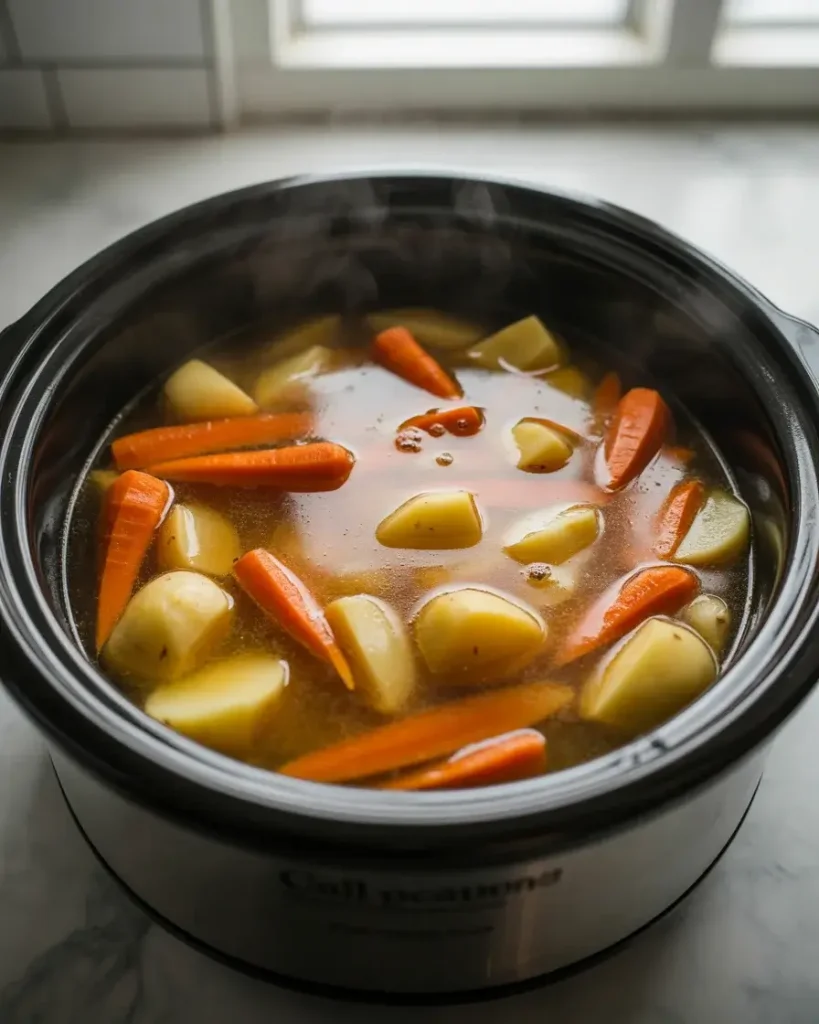
Cook on LOW for 7-8 hours or HIGH for 4-5 hours. You’ll know it’s ready when a fork slides into the potatoes with zero resistance and the broth has deepened to a rich amber color.
I always use LOW when I can. The difference in flavor between LOW/8 hours versus HIGH/4 hours is noticeable. The slow cook pulls so much more sweetness out of the carrots and onion. Patience is genuinely rewarded here.
Step 4: Blend Part of the Soup
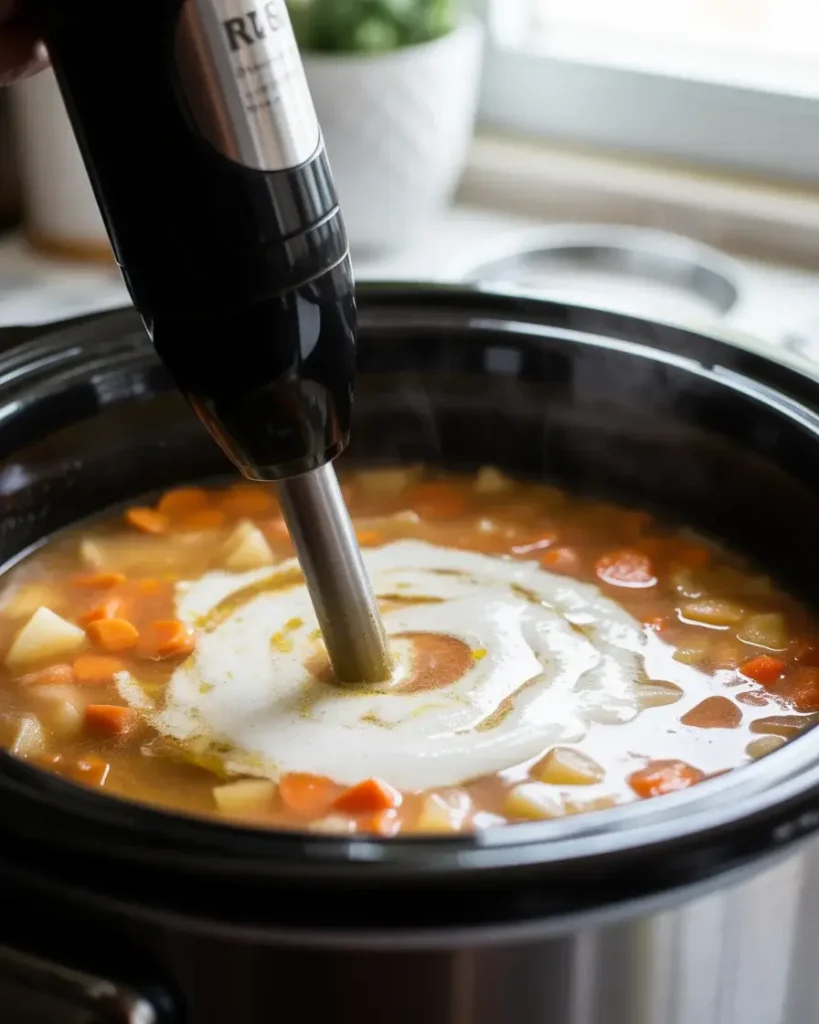
Use an immersion blender to partially blend the soup, about 8-10 pulses. You want roughly half the vegetables blended and half left chunky. This is the technique that creates that creamy body without any actual cream yet.
The first time I fully blended it, I lost all the texture and it felt more like baby food than soup. The partial blend is the sweet spot. If you only have a countertop blender, scoop out about 2 cups, blend them smooth, and stir back in.
Get More Delicious Recipes
Step 5: Stir In the Cream
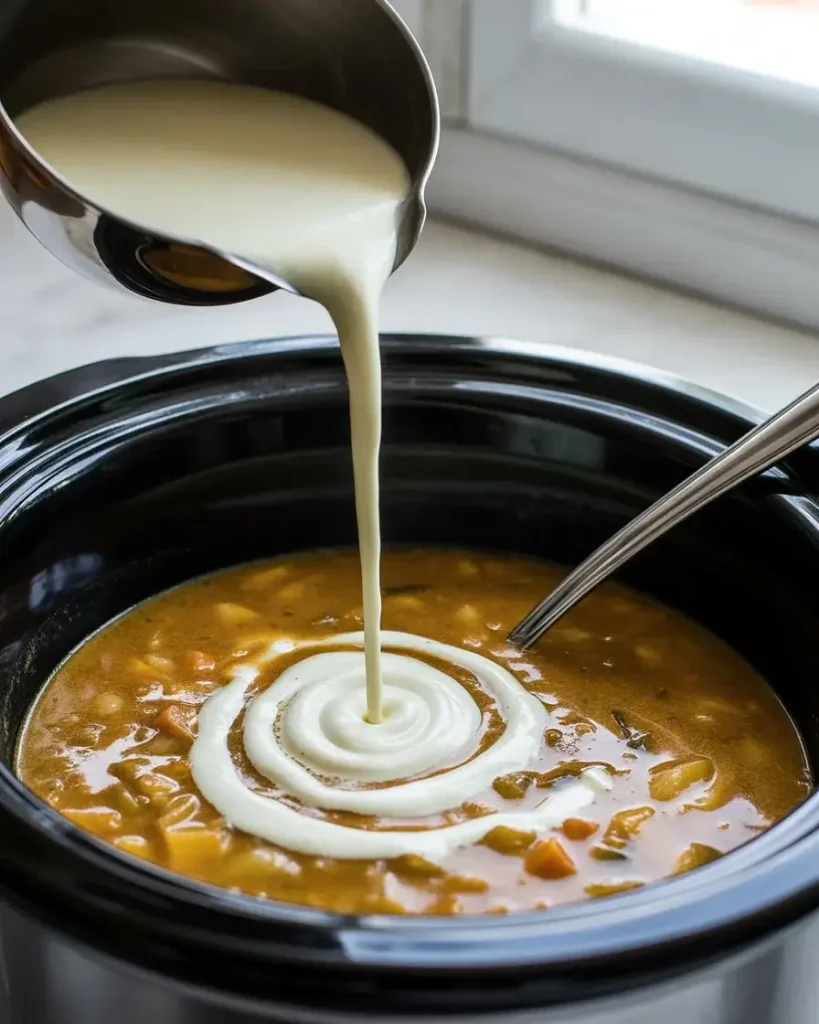
Turn the slow cooker to WARM, then stir in 3/4 cup of heavy cream. This is the step I failed at early on. Adding cream while still on HIGH caused it to curdle and separate. WARM or completely off is the safe zone.
Stir slowly and watch the soup turn from golden amber to a beautiful pale ivory. Let it sit on WARM for 10 minutes before serving so the cream fully incorporates. The texture at this point should be velvety and thick, coating the back of your spoon.
Step 6: Season and Serve

Taste and adjust salt (I usually add about 1.5 teaspoons total), a squeeze of lemon juice, and a pinch of white pepper. The lemon is something I added by accident in batch 9 and never removed because it brightens everything.
Ladle into bowls and top with shredded sharp cheddar, a swirl of sour cream, fresh chives, and cracked black pepper. The contrast of the hot creamy soup with the cool sour cream on top is genuinely one of my favorite things about this recipe.

Slow Cooker Creamy Vegetable Soup
Course: DinnerCuisine: American Comfort FoodDifficulty: Easy4
20
minutes8
hours8
hours20
minutesA rich, velvety slow cooker vegetable soup made creamy through partial blending and finished with heavy cream. Hands-off, deeply flavorful, and endlessly customizable.
Ingredients
3 medium carrots, diced (about 2 cups)
3 stalks celery, diced
3 medium Yukon gold potatoes, peeled and diced (about 3 cups)
1 large yellow onion, diced
4 garlic cloves, minced
1 cup frozen or fresh corn kernels
4 cups vegetable broth
1 teaspoon dried thyme
1 teaspoon dried rosemary
1 teaspoon smoked paprika
1.5 teaspoons salt (adjust to taste)
1/2 teaspoon black pepper
3/4 cup heavy cream
1 tablespoon lemon juice
Fresh chives, shredded cheddar, and sour cream for topping
Directions
- Dice carrots, potatoes, celery, and onion into 3/4-inch uniform pieces. Mince garlic.
- Layer all vegetables into the slow cooker. Add vegetable broth, thyme, rosemary, smoked paprika, salt, and pepper. Stir briefly.
- Cook on LOW for 7-8 hours or HIGH for 4-5 hours, until potatoes are completely fork-tender.
- Turn slow cooker to WARM. Use an immersion blender to partially blend the soup with 8-10 pulses, leaving half the vegetables intact.
- Stir in heavy cream slowly and add lemon juice. Let sit on WARM for 10 minutes.
- Taste and adjust salt. Ladle into bowls and top with shredded cheddar, sour cream, and fresh chives.
Notes
- Store in an airtight container in the fridge for up to 4 days. Reheat on the stovetop over medium-low heat, stirring frequently.
For freezing, freeze the soup before adding cream. Stir in fresh cream when reheating.
Dairy-free option: substitute full-fat coconut cream or cashew cream for the heavy cream.
Add zucchini or broccoli in the last 30-60 minutes only to prevent overcooking.
For a thicker soup, add an extra potato or let the blended soup sit on WARM uncovered for 15 minutes.
Nutrition Table (per serving)
| Nutrient | Amount |
|---|---|
| Calories | 285 |
| Total Fat | 14g |
| Sugars | 7g |
| Protein | 6g |
Trusted Resource Links: For guidance on safe vegetable handling and storage, visit the FDA Safe Food Handling page. For nutrition information on a vegetable-forward diet, the American Heart Association Healthy Eating guide is a helpful reference.
Can You Use Frozen Vegetables in This Soup?
Yes, you can use frozen vegetables and the results are genuinely solid when you handle them right. I tested bags of frozen mixed vegetables in 4 batches and found that thawing them completely before adding made a noticeable difference in final texture.
Frozen vegetables release a lot of extra water as they cook. If you add them straight from frozen, your broth gets diluted and the flavor thins out. Thawing first and patting them dry with a paper towel before adding keeps the broth rich and properly seasoned throughout the cook.
The one downside is that frozen vegetables soften faster than fresh. I reduce the cook time by about 1 hour when using frozen, checking at the 6-hour mark on LOW instead of 7-8. The texture still turns out nicely creamy after partial blending.
What Makes This Soup So Creamy Without a Roux?
The partial blending technique does most of the work. Blending the starchy potatoes and softened carrots creates a naturally thick, velvety base without needing any butter-flour roux.
After testing 6 different thickening methods (cornstarch slurry, roux, cream cheese, blending only, cream only, and combination), the partial blend plus cream at the end consistently won for texture and flavor. The starch from the potatoes is genuinely powerful.
The amount you blend matters too. I found 8-10 pulses with an immersion blender hits the right balance. Less than that and the soup stays too broth-forward. More than that and you lose all the chunky texture that makes this satisfying.
How Do You Store and Reheat This Without the Cream Breaking?
Stored properly in an airtight container, this soup keeps well in the fridge for up to 4 days. The cream does not separate when reheated gently, which surprised me the first few times because I expected it to be finicky.
The key is reheating on the stovetop over medium-low heat, stirring frequently, rather than microwaving on high. Microwaving at full power twice caused slight separation in my tests. A lower power setting (50-60%) with stirring halfway through works fine.
For freezing, I recommend freezing the soup before adding the cream. I tested frozen portions with cream already mixed in and the texture after thawing was noticeably grainy. Just freeze the base, then stir in fresh cream when reheating. It tastes like you just made it.
Which Vegetables Work Best in This Recipe?
Potatoes are non-negotiable for the creamy base they create when blended. Beyond that, carrots, celery, and onion are the backbone of the flavor. Parsnips are an underrated swap for some of the carrot that I tested in batch 12 and really loved.
Zucchini and peas should be added in the last 30 minutes only. I learned that the hard way after adding zucchini at the start and ending up with a mushy green mess by hour 7. Delicate vegetables genuinely cannot handle that long a cook time.
Corn kernels (frozen or fresh) hold up beautifully for the full cook time and add a slight sweetness that balances the savory broth. Broccoli florets work if added in the final hour. Avoid any vegetable with a very high water content like cucumber or lettuce, which turn to mush and water things down.
Can You Make This Dairy-Free?
Absolutely, and the dairy-free version is one I actually keep in regular rotation now. Full-fat coconut cream is the best substitute, adding richness without any coconut flavor when combined with the savory herbs and garlic.
I tested oat milk, almond milk, coconut cream, and cashew cream across 4 dairy-free batches. Oat milk and almond milk both produced a noticeably thinner soup that felt more like a broth than a creamy vegetable soup. Cashew cream and coconut cream were the clear winners.
For cashew cream, blend 1/2 cup of soaked raw cashews with 1/2 cup water until completely smooth, then stir it in exactly as you would the heavy cream, on WARM. It creates a beautifully thick, neutral-flavored base that nobody at my table has ever identified as dairy-free.
Frequently Asked Questions
Q: Can I cook this on HIGH instead of LOW?
A: Yes, cook on HIGH for 4-5 hours. The flavor is slightly less developed than the LOW method, but the texture is still creamy and satisfying. I always recommend LOW when you have the time.
Q: Do I have to use an immersion blender?
A: No, a countertop blender works fine. Scoop out about 2 cups of cooked soup, blend until smooth, then stir it back in. Just be careful with the hot liquid and avoid filling the blender more than halfway.
Q: Can I add protein to this soup?
A: Absolutely. White beans stirred in during the last hour add great protein without changing the flavor. Cooked shredded chicken or chickpeas also work really well and hold up to the creamy base beautifully.